Nigeria: 2027 Presidency – Obi, Kwankwaso Formalise Single Four-Term Accord

Rabiu Kwankwaso says two written agreements commit Mr Obi to serving only one four-year term if elected president, after which the NDC would support returning the presidency to Northern Nigeria in 2031.
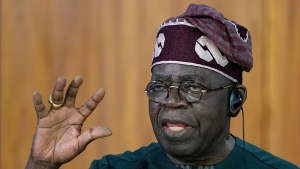
Rabiu Kwankwaso, the vice-presidential candidate of the Nigeria Democratic Congress (NDC), has stated that Peter Obi, the party’s presidential candidate, signed two agreements committing himself to serving only one four-year term if elected in 2027.
Mr Kwankwaso explained that the documents comprise a formal agreement involving the political party and a separate personal accord between himself and Mr Obi. The former Kano State governor disclosed this information during an appearance on Channels Television’s Politics Today on Monday, 20 July.
According to Mr Kwankwaso, the agreement stipulates that the presidency will return to Northern Nigeria in 2031 upon the completion of an Obi-led administration’s four-year tenure.
“We have agreed to formalise it in writing,” Mr Kwankwaso stated. “We have executed one document for the party and another between the two of us.”
When asked whether he believed Mr Obi would honour his pledge and resist pressure to seek a second term, Mr Kwankwaso expressed confidence, noting that his interactions with the former Anambra State governor had convinced him that he would respect the agreement. “I personally believe him, and, based on what I now know about him, I do not believe he will change his mind when the time comes,” he said. “We are all gentlemen.”
Mr Kwankwaso added that he and Mr Obi would continue to collaborate after the proposed administration completes its term. “The agreement is that after four years, we will continue to work together as a group, as a party, and as friends and brothers,” he said. “After our four-year term, from 2027 to 2031, power returns to the North. That is the consensus.”
The former defence minister did not state that he would be the NDC presidential candidate in 2031; his comments referred broadly to the presidency returning to the North, rather than to his personal political ambitions.
Copies of the two agreements have not been made public, and PREMIUM TIMES has not independently reviewed their terms. Consequently, it remains unclear whether the documents contain enforcement mechanisms, sanctions for a breach, or provisions detailing how the NDC would select a northern presidential candidate in 2031. Mr Obi has repeatedly pledged to serve only one term if elected; however, he has yet to publicly confirm the specific details of the documents described by Mr Kwankwaso.
From failed 2023 partnership to joint ticket
This agreement marks a significant shift in the political relationship between Messrs Obi and Kwankwaso, whose attempts to ally ahead of the 2023 presidential election collapsed. At the time, Mr Obi was the Labour Party presidential candidate, while Mr Kwankwaso contested on the platform of the New Nigeria Peoples Party (NNPP).
Although both parties discussed a joint ticket, negotiations stalled after they failed to agree on the presidential and vice-presidential roles. They ultimately contested separately; Mr Obi finished third, while Mr Kwankwaso placed fourth, though he secured a victory in Kano State, the base of his Kwankwassiya political movement.
Reflecting on their previous disagreement, Mr Kwankwaso noted that their relationship has evolved as he has gained a deeper understanding of Mr Obi’s vision. “I now recognise that Peter is a serious politician who has this country at heart. He is someone to be relied upon,” he said.
“When we compared our blueprints, we realised that we share a similar vision and mission for the country. That was why it was easy for us to agree to work together as a family.”
Their journey through ADC
Following the 2023 election, Messrs Obi and Kwankwaso engaged in renewed negotiations to unite opposition parties against President Bola Tinubu and the All Progressives Congress. They later joined other prominent opposition politicians–including former Vice President Atiku Abubakar, former Transportation Minister Rotimi Amaechi, former Senate President David Mark, and former Osun State Governor Rauf Aregbesola–under a coalition built around the African Democratic Congress (ADC).
The ADC arrangement was intended to prevent a repeat of the opposition vote-splitting that contributed to Mr Tinubu’s 2023 victory. On 25 April, coalition leaders agreed to support a single presidential candidate against the incumbent. The agreement, known as the Ibadan Declaration, sought to consolidate political structures ahead of the 2027 election. However, the coalition became divided over issues regarding zoning, the presidential ticket, party leadership, and pending court cases. Messrs Obi and Kwankwaso eventually withdrew, citing legal and organisational crises within the ADC. Their departure weakened the coalition’s efforts, and although the ADC maintained that it would survive, the loss was seen as a significant setback. Atiku later secured the ADC presidential ticket, setting the stage for an election where major opposition candidates may compete separately.
NDC invitation and emergence of the ticket
Before Messrs Obi and Kwankwaso’s formal departure from the ADC, their supporters had begun promoting a potential joint ticket via the “OK Movement”–an organisation established to mobilise support for an Obi-Kwankwaso partnership. On 26 April, the NDC openly invited both politicians to join the party. They formally joined on 3 May, receiving membership cards at the party’s national secretariat in Abuja.
At the NDC convention on 9 May, Mr Kwankwaso supported the party’s decision to zone its presidential ticket to Southern Nigeria. Mr Obi was subsequently screened and cleared for the party’s presidential primary before being ratified as its candidate on 30 May. He announced Mr Kwankwaso as his running mate, affirming that the former Kano governor would be a partner in government. The one-term agreement appears to explain the compromise that enabled Mr Kwankwaso to support the zoning of the ticket to the South and accept the vice-presidential nomination.
Kwankwaso dismisses doubts about northern support
During the interview, Mr Kwankwaso rejected claims by former Borno State Governor Ali Modu Sheriff that northern voters would not support Mr Obi in 2027. He argued that Mr Sheriff’s assessment did not reflect the reality in Kano and other northern states.
Mr Kwankwaso noted that Mr Obi is no stranger to electoral contests in Northern Nigeria, citing his performance during the 2023 presidential election. “In the last election, he contested and received over two million votes in Northern Nigeria, and by any standard, two million is a significant figure,” he stated.
His argument highlights the electoral calculation behind the NDC ticket: combining Mr Obi’s support among young voters, the South-east, and parts of the North-central with Mr Kwankwaso’s political machinery in Kano. However, analysts have questioned whether Mr Kwankwaso’s influence extends substantially beyond Kano into other North-west states, and the NDC ticket must also compete against Mr Atiku and other candidates.
The disclosure of the written agreement is likely to become a central component of the NDC’s efforts to reassure northern political leaders and voters that an Obi presidency would conclude after four years. Until the documents are released or their provisions are independently verified, the proposed transition remains a political commitment rather than a legally enforceable constitutional arrangement.
By Premium Times.