Liberia: Justice Ministry ‘Not Eager for Conviction,’ but Justice

Justice Minister Cllr. N. Oswald Tweh has issued a strong warning to prosecutors across Liberia, declaring that the Ministry of Justice is not interested in securing convictions at all costs but in ensuring that justice is achieved through fairness, integrity, and strict adherence to the law.
Minister Tweh said prosecutors must understand that their responsibility extends beyond winning cases, emphasizing that they represent not only the Republic of Liberia but also the broader principle of justice.
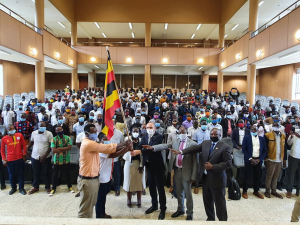
He made the remarks Tuesday, August 4, 2026, when he addressed prosecutors, county attorneys, and justice sector officials at the opening of a three-day prosecution capacity-building workshop in Ganta, Nimba County.
The workshop, organized by the Ministry of Justice through the Office of the Solicitor General, seeks to strengthen the capacity of prosecutors through improved evidence management, legal strategy, ethical practices, and effective case preparation.
Delivering the keynote address, Minister Tweh drew a clear line on prosecutorial conduct, cautioning lawyers against shortcuts, selective justice, and practices that could undermine public confidence in Liberia’s justice system.
“The Ministry of Justice is not eager for conviction. Rather, this Ministry wants justice earned the right way and can be defended on solid ground, delivered by prosecutors the country can trust,” Tweh said.
He described the role of prosecutors as one of the most demanding positions within the justice system because of the unique responsibility they carry.
According to him, defense lawyers have the duty to represent their clients zealously within the bounds of the law, while judges are responsible for weighing cases fairly and making decisions based on evidence and legal principles.
Prosecutors, however, carry a dual responsibility because they represent both the state and the pursuit of justice itself.
“You represent the Republic of Liberia and also represent justice itself,” Tweh told prosecutors.
“Your duty is not merely to win, but it is to see that justice is done,” he added.
The Justice Minister warned that prosecutors who become focused only on obtaining convictions risk abandoning their true responsibility and transforming themselves into instruments of punishment rather than defenders of justice.
“That distinction is not a small one, rather it is everything — a prosecutor who forgets it stops being a minister of justice and becomes something else entirely; an instrument of conviction at any cost,” Tweh cautioned.
He stressed that even when a guilty person is convicted through improper means, the damage extends beyond the individual case because public confidence in the justice system is weakened.
“When prosecutors want conviction at all cost and even when a guilty person is convicted, something innocent dies alongside them — public trust in the process that convicted them,” he explained.
Tweh said a conviction achieved through misconduct does not represent a victory for the government but creates future liabilities, including appeals, wrongful conviction claims, public embarrassment, and loss of confidence in Liberia’s courts.
“A conviction obtained the wrong way is not a victory for the state, but rather a liability that awaits to be paid for,” he said.
He warned that prosecutorial misconduct often begins through small compromises that may appear reasonable at the moment but eventually damage cases and institutions.
“Misconduct rarely announces itself, creeping in through shortcuts that feel reasonable in the moment,” Tweh noted.
He identified withholding evidence favorable to an accused person as one of the serious forms of misconduct prosecutors must avoid, reminding them that disclosure of such information is a legal and ethical obligation.
“Our law and our conscience, both demand that exculpatory evidence be turned over — that is not optional, and it is not a courtesy to the defense, rather it is your legal and ethical obligation,” he said.
The Justice Minister also warned prosecutors against overcharging defendants by adding charges they know cannot be proven simply to pressure accused persons into pleas or punish them before trial.
“It looks like overcharging a defendant, piling on charges you know you cannot prove, intended simply to pressurize a plea or to punish someone before they have even been tried,” he stated.
He cautioned against allowing political influence, personal relationships, or the identity of an accused person to determine how vigorously cases are prosecuted.
“Selective justice is injustice with a different face,” Tweh declared.
He further warned prosecutors against manipulating witnesses, making inflammatory courtroom statements, relying on facts not presented as evidence, or appealing to emotions and prejudice rather than proof.
“Selective justice also looks like courtroom conduct, inflammatory remarks to a jury, commenting on facts not in evidence, appeals to prejudice rather than proof, all designed to win by emotion what cannot be won by evidence,” he said.
Tweh also urged prosecutors to hold one another accountable, warning that silence in the face of wrongdoing can also contribute to injustice.
“It looks like watching a colleague cut corners and saying nothing, because it is not your file, not your county, not your problem,” he stated.
He said Liberia’s justice sector is currently under greater scrutiny than ever before, making prosecutorial integrity essential to restoring confidence in the rule of law.
“Some of you may ask, why is the Minister raising this now, but I will tell you plainly that Liberia is at a point where our justice sector is under more scrutiny, and rightly so, than at almost any time in our recent history,” Tweh said.
He noted that citizens, international partners, and investors are closely watching Liberia’s justice system because the rule of law directly affects confidence in the country.
“Our partners are watching that the citizens are watching and the investors are weighing whether to bring their capital into this country, because the rule of law is not a slogan to them. It is a risk calculation,” he explained.
According to Tweh, every case that collapses because of misconduct and every conviction overturned because a prosecutor failed to follow proper procedures weakens Liberia’s efforts to demonstrate that justice is administered fairly and independently.
“Every time a case collapses because of misconduct, every time a conviction is overturned because a prosecutor cut a corner, we do not just lose that case — we lose ground in the larger fight to convince Liberians and the world that justice in this country is administered fairly, competently, and without fear or favor,” he said.
The Justice Minister reminded county attorneys and prosecution monitors that they represent the face of the Ministry of Justice in every county, courtroom, and community, and must ensure that government commitments to justice reform become reality.
He encouraged prosecutors to know and follow the Rules of Professional Conduct governing lawyers in Liberia, as well as prosecutorial guidelines issued by the Ministry of Justice. He urged them to disclose evidence whenever there is uncertainty about whether it may benefit an accused person, document decisions involving charges and case management, and seek guidance from senior officials whenever they face difficult cases or external pressure.
“A prosecutor who can explain his or her reasoning in writing is a prosecutor who is protected, and who protects this Ministry, when that decision is later questioned,” Tweh said.
He assured prosecutors that the Ministry would stand behind those who uphold professional standards, even when doing so requires difficult decisions.
“This Ministry will stand behind every prosecutor who does the job the right way, even when the right way is the harder way, even when it means losing a case you wanted to win,” he said.
However, he warned that the Ministry would not defend actions that undermine Liberia’s justice system or violate citizens’ rights.
“This Ministry will not stand behind conduct that embarrasses the Republic of Liberia or robs a Liberian citizen of a fair process. That line will be held,” Tweh declared.
The three-day workshop brought together prosecutors from Liberia’s 15 counties, along with city solicitors from the host region and other justice sector actors.
Solicitor General Cllr. Fayia said the training forms part of a quarterly initiative aimed at strengthening prosecutors’ professional capacity, reviewing previous activities, and identifying better strategies for improving criminal prosecution.
He said the workshop provides prosecutors with an opportunity to exchange experiences and develop practical approaches to improve justice delivery across the country.
The sessions cover several areas, including strengthening criminal prosecution through effective evidence gathering and management, mutual legal assistance, cross-border corruption and international cooperation, understanding trafficking-in-persons offenses, developing prosecution strategies, and improving case management.
Minister Tweh also thanked Solicitor General Cllr. Fayia for organizing the workshop and conveyed greetings from President Joseph Nyuma Boakai, whom he said continues to prioritize justice reform and the strengthening of Liberia’s prosecutorial system as a key part of his administration’s agenda.