Libya: Can the African Union Remain Relevant in Libya?
Unless the AU can help coordinate implementation of existing peace initiatives, its influence on the ground may continue to wane.
Fifteen years after the 2011 uprising that toppled Muammar Gaddafi, Libya remains fragmented. Rival eastern and western power centres prevent total collapse but block meaningful national reconciliation, institutional unification and democratic transition.
Instability fuels arms trafficking, organised crime, irregular migration, terrorism and foreign fighter movements across the Sahel and beyond. With Africa’s largest oil reserves and about 150 armed groups, competition for resources exacerbates the crisis.
Libya has long been one of the African Union’s (AU) most important files. The Peace and Security Council (PSC) has held at least 20 meetings on Libya since February 2011, and the AU High-Level Committee on Libya is the organisation’s main vehicle for an African-led settlement.
In Libya’s crowded mediation landscape, the AU stands out for its distinctive role in reconciliation. But can it use this position to align existing initiatives and ensure their implementation?
Recent developments suggest cautious but significant diplomatic progress in Libya. In January, the Presidential Council and the Government of National Unity in the west of the country signed the Charter for Peace and National Reconciliation. Other groups had signed in February 2025 after the AU facilitated the charter.
Other advances this year are the 11 April approval by rival administrations of the country’s first unified budget in more than a decade. In another first, a joint military exercise facilitated by the United States in March brought together top rival commanders.
On 30 August, adversaries agreed on a ‘landmark’ roadmap to national elections within two years, mediated by the UN Support Mission in Libya (UNSMIL). This follows a parallel, largely Libyan-led tripartite agreement signed on 16 June, which commits the parties to simultaneous presidential and parliamentary elections by 17 February 2027, establishes a sovereign oversight committee, and outlines steps to end the transition.
AU Commission Chairperson Mahamoud Ali Youssouf welcomed the June agreement as a step towards constitutional order and reconciliation. By contrast, UN Secretary-General Special Representative Hanna Tetteh didn’t mention it in her 18 June remarks, instead prioritising the UNSMIL facilitate- roadmap.
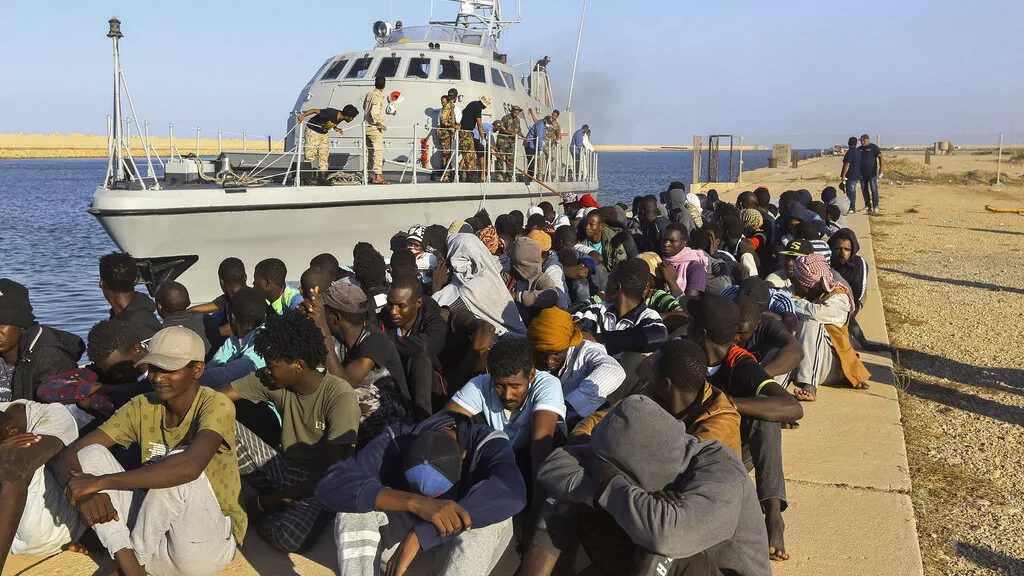
In addition to Libya’s overlapping peace processes, security and other concerns remain. At its 9 June meeting, the PSC reiterated calls for all foreign forces and mercenaries to withdraw and expressed concern over continued violations of the United Nations (UN) embargo, illicit fuel exports, armed clashes and deteriorating humanitarian conditions of African migrants in detention centres.
It recognised that Libya’s core challenge was not a lack of peace efforts, but a persistent failure to implement existing agreements – at least nine major roadmaps or accords have been launched since 2011.
Libya’s accords consistently collapse or stall at implementation. As the Tripoli-based Sadeq Institute’s Anas El Gomati told ISS Today, ‘Endorsement is not implementation.’ The core obstacles are institutional and economic. Rival authorities in the east and west benefit politically and financially from maintaining parallel institutions – particularly through controlling oil revenues and state resources.
Oil revenues sustain competing security structures, administrations, judicial bodies and financial networks. El Gomati says elections won’t resolve the crisis without deeper institution-building, public finance and security reforms.
External actors add to the complexity. El Gomati says the United Arab Emirates has faced little consequence or mediation attention despite being the primary external military patron of Khalifa Haftar’s eastern-aligned Libyan National Army (LNA) since 2016. LNA-controlled territories also reportedly serve as a supply corridor for Sudan’s Rapid Support Forces.
The PSC has rejected the presence of foreign forces, mercenaries and fighters. However, the 5+5 Joint Military Commission, comprising military negotiators representing both east and west, says fragmented security sector institutions hamper external force withdrawals.
In this environment, overlapping peace initiatives – the UN roadmap, AU efforts and the tripartite agreement – risk duplication and forum-shopping. Greater coordination is essential to turn recent diplomatic momentum into lasting impact.
Implementation of the AU’s 2011 roadmap and high-level committee decisions has been slow due to external factors (foreign interference and competing mediation tracks) and internal constraints (limited follow-up capacity and resources, and competing continental priorities).
Nevertheless, a clear example of the AU’s added value is the 2025 National Reconciliation Charter. The initiative brings together opposing power centres, has helped bridge Libya’s political and geographical divide, and has contributed to diplomatic momentum. Unlike other actors in Libya focused on elections and institutions, the AU frames the crisis as both political and societal and prioritises national reconciliation, transitional justice and social cohesion.
The AU also collaborated with Africa’s three UN Security Council members and the United Kingdom (as Libya’s penholder) to secure the unanimous April 2026 adoption of Resolution 2819, which extended Libya’s sanctions regime.
But unless the AU can help harmonise the implementation of existing peace initiatives, its influence on the ground may continue to wane.
The PSC should help coordinate action on the tripartite agreement, the UN roadmap and the reconciliation charter. This would reduce duplication and advance institutional reunification and the conduct of credible elections by the end of 2027. The PSC should also expedite its field mission to Libya and the relocation of the AU Liaison Office from Tunis to Tripoli, as agreed by the AU in 2022.
The AU’s relevance in Libya will depend not on new initiatives, but on its ability to act as coordinator and guarantor of implementation in a landscape dominated by powerful external players and fragmented domestic interests.
By ISS.