Africa: Climate’s Most Catalytic Capital Knows Exactly Where to Go – Africa’s Rainforest Basins
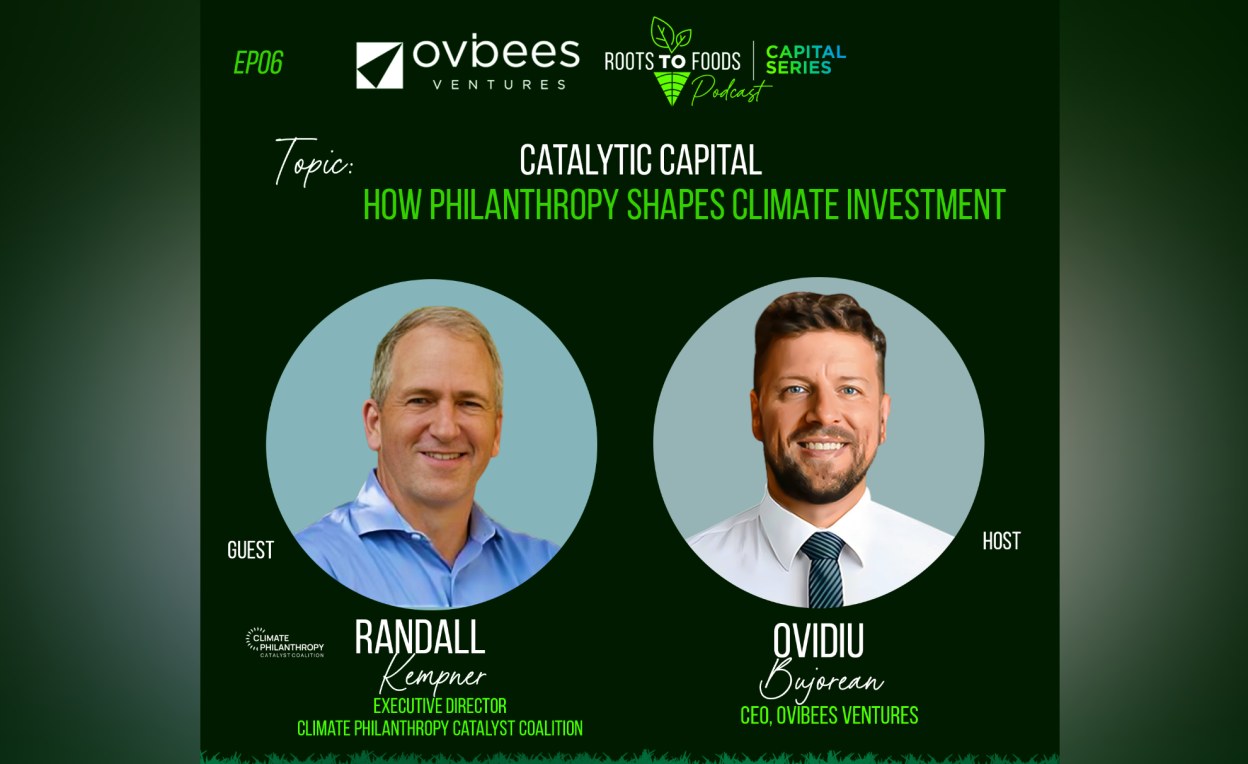
In a RootsToFoods Capital Series interview opening Wave 2 of the series, Randall Kempner — Executive Director of the Climate Philanthropy Catalyst Coalition and founding executive director of the Aspen Network for Development Entrepreneurs — argues that philanthropy is a distinct category of capital built to move first, with its highest-leverage ground overlapping the Amazon and the Congo Basin.
Ovidiu Bujorean, chief executive officer of OviBees Ventures, spoke with Randall Kempner — Executive Director of the Climate Philanthropy Catalyst Coalition and founding executive director of the Aspen Network for Development Entrepreneurs (ANDE) — as Wave 2 of the RootsToFoods Capital Series opened. Kempner named the one form of capital built to move before anything else can: philanthropy. Not as a synonym for blended finance, he said, but as a structurally distinct category of capital that can take more risk, sustain longer time horizons, and build the ecosystem conditions that no commercial actor can justify building alone.
Climate’s underinvestment, Kempner argued, is not primarily a deployment problem but a prioritization one. Climate has never accounted for more than roughly 2% of total global philanthropy — a share that, even at its historic high today, still leaves the overwhelming majority of philanthropic dollars going elsewhere. When a group of U.S. foundations was asked why they did not fund climate work, 80% said it simply was not on their mission statement, even as climate change increasingly bears on every cause those foundations do fund.
“Philanthropy should be the first in — period. Because it has a unique role, it can take more risk, support pilots, build ecosystems, and recognize that its goal is completely social impact. Its job is to do the research, be the guarantor, and put its money in knowing it is at risk — so that others can follow.” — Randall Kempner, Executive Director, Climate Philanthropy Catalyst Coalition
The bigger opportunity, Kempner said, sits not in the grant check but on the balance sheet behind it. U.S. foundations are required to pay out only 5% of their endowment each year; a $50 million foundation disburses roughly $2.5 million annually while the remaining $47.5 million sits invested, often with no connection to its philanthropic mission at all. “Why is that money not working for your mission? And it should,” he said, pointing to the Russell Family Foundation as a model: a mid-sized funder that has aligned its entire portfolio — grants and investments alike — with its climate and environment priorities, and publishes its results annually so other foundations can see the approach works.
Most philanthropists, Kempner said, still behave like the business people they were before they became philanthropists, maintaining a strict wall between grant-making and investing. Breaking that wall down is where guarantee-focused nonprofits such as MCE Social Capital come in: they deploy philanthropic guarantees that unlock commercial capital in return for the principal, not a market return.
Kempner’s own proof point predates his current role. At ANDE, which he led for more than a decade, philanthropists funded not a single organization but an entire field of entrepreneurship-support groups — unglamorous infrastructure work that few foundations want to underwrite. The clearest signal it worked, he said, came the day ANDE’s Capacity Development Fund moved more than $1 million in philanthropic funding to its member organizations and other groups supporting small and growing businesses across emerging markets.
Asked for an example of philanthropic capital doing something structurally impossible any other way, Kempner pointed to the Gates Foundation’s campaign to eradicate polio: decades of funding to reach the last children in the hardest-to-reach places, with no financial return and a horizon long enough to outlast multiple political cycles. Gates funded the unglamorous groundwork — cold chains, health-worker training, data systems — while coordinating governments, the World Health Organization, UNICEF and vaccine manufacturers. “This was not something that was going to be solved by markets alone,” he said.
Political headwinds in the United States, Kempner said, leave philanthropists three choices when policy support weakens: keep fighting — including through legal defense of funding that was withdrawn — change the battlefield, or flee. Fleeing is the one wrong answer, he said; a quieter version of it, “green hushing,” where funders keep working but stop talking about it, is already visible in parts of the sector. Changing the battlefield means directing capital toward geographies where governments, businesses and the public are receptive to climate action — Brazil, Indonesia, India and parts of Africa among them — and toward the highest-leverage solution type: preserving existing rainforests, mangroves and other natural carbon sinks, rather than funding new ones. The two overlap most clearly, he said, in the Amazon and the Congo Basin.
“Climate philanthropy at its best,” Kempner said, “looks like driving capital to the most impactful climate solutions in a way that crowds in additional funders.”