
Can AI beats beat the official World Cup song?
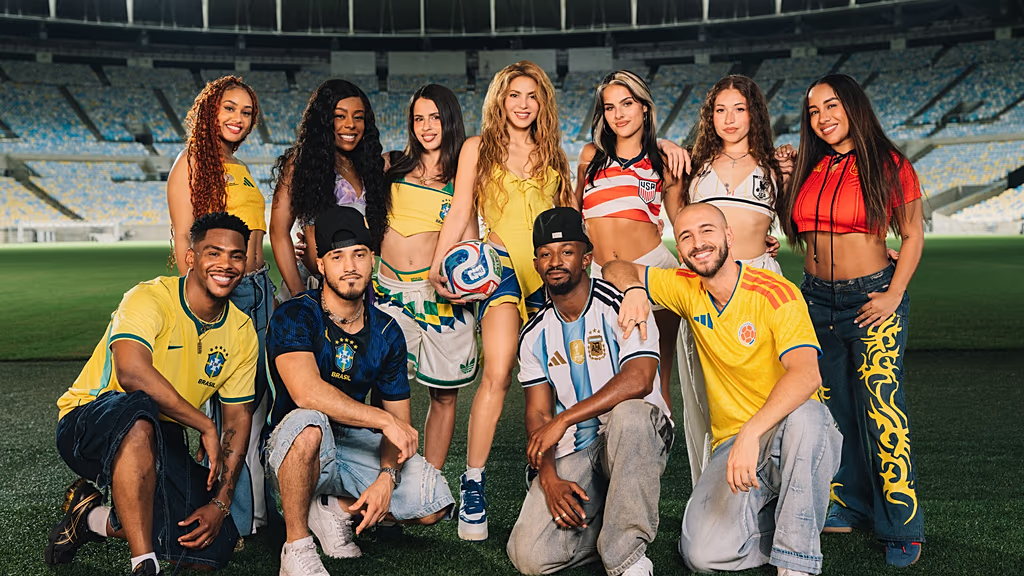
Though the official 2026 FIFA World Cup song has been released, football fans and the creator community could not wait. Across social media, supporters and online creators are using artificial intelligence to produce their own anthems, turning platforms like YouTube, TikTok and Instagram into unofficial music studios for the global game.
These AI‑generated tracks are now generating up millions of views, reshaping how fans connect with their teams and raising fundamental questions about creativity, copyright and the future of football music.
The trend appears to have gained momentum with songs such as “light up the world”, a fan‑made track dedicated to France and widely shared online. The track was created by an individual under an AI generated music band group Coda Global Ensemble.
Its success sparked imitations for other nations, including Brazil, Portugal, Argentina and Germany, with creators adopting similar styles: chant‑style lyrics, stadium‑style drums and easily repeatable hooks that translate well into short‑form videos.
What makes the shift striking is how simple the process has become. A typical creator will type a prompt such as “a stadium anthem for Team X with a marching beat and crowd vocals” into an AI‑music generator, then refine the stems, add extra layers of crowd noise, and pair the final mix with AI‑generated visuals of players, stadiums and national colours.
Tutorials on platforms like YouTube show how a single creator can produce a full anthem and matching video in under an hour, blurring the line between fan and professional producer.
This ecosystem sits at the heart of the modern creator economy. Instead of only consuming official songs released by record labels and FIFA partners, fans are producing their own versions of the sound they want to associate with their team.
Some listeners even argue that these AI‑made anthems feel more authentic or more energetic than the polished but generic tracks that have defined past World Cups. In this sense, the AI‑anthem wave is not just a technical novelty, it is a reflection of how football fandom has become decentralised, participatory and driven by social media attention.
Yet the trend is not without controversy. Music rights‑holders and legal experts are asking who owns an AI‑generated song if the model has been trained on thousands of existing recordings.
Concerns are growing that revenue from popular anthems may bypass the original artists and songwriters whose work indirectly shaped the output. At the same time, the use of team names, club badges and national symbols in unlicensed fan content raises questions about trademarks and intellectual property, especially when creators seek to monetise views and sponsorships around the tournament.
There are also more subtle questions about musical identity. For decades, World Cup anthems have helped nations project a sense of character and unity, from reggae and pop to Latin and Afrobeat.
If more of these anthems are stitched together by algorithms rather than by human songwriters steeped in those cultures, the result could be a homogenised, formulaic “global football sound” that flattens local voices.
For now, though, the AI‑anthem boom shows how deeply football culture has merged with the tools of digital creation. Algorithms are no longer just ranking players, predicting scores or editing highlights, they are also helping to compose the soundtrack of the game.
What began as a few fan experiments has turned into a broader movement: supporters are no longer only singing in the stands. They are using AI to write the songs they want to hear, and in the process, they are reshaping what it means to be a football fan in the digital age.

