
Congo-Kinshasa: As Ebola Resurfaces in DR Congo, So Do Critical Questions About How to Respond
Bunia & Goma, Democratic Republic of the Congo — “It’s going to be a real race against time.”
A large-scale response has begun to an Ebola outbreak in the Democratic Republic of the Congo that went undetected for up to two months and has already become one of the largest on record, with 671 suspected cases and 160 suspected deaths.
But funding limitations for the Congolese government and international responders, political and security dynamics in the outbreak zone, and troubled responses to past Ebola epidemics in DRC are raising concerns about efforts to contain the spread.
“We are trying to fight the disease with the equipment and resources available in order to save our people, who have already suffered from insecurity for a long time and now face a new ordeal,” said Chérubin Radjabu, a nurse in the outbreak area.
The epidemic, centred in Ituri province but with cases in North Kivu, South Kivu, and neighbouring Uganda, involves the extremely rare Bundibugyo variant, for which there have been only two past outbreaks and are no approved vaccines or treatments.
The severity of the situation led World Health Organization chief Tedros Adhanom Ghebreyesus to fast-track the declaration on 17 May of a public health emergency of international concern, which allows for greater mobilisation of resources.
A zoonotic disease that spreads from animals to humans, and then between people, Ebola is less transmissible than many other infectious diseases, spreading through direct contact with an infected person’s blood or body fluids.
WHO says the outbreak does not pose a pandemic threat, but still presents a severe national and regional health risk, given the up to 50% fatality rate of Bundibugyo, and the lack of vaccines and therapeutics, which are available for other strains.
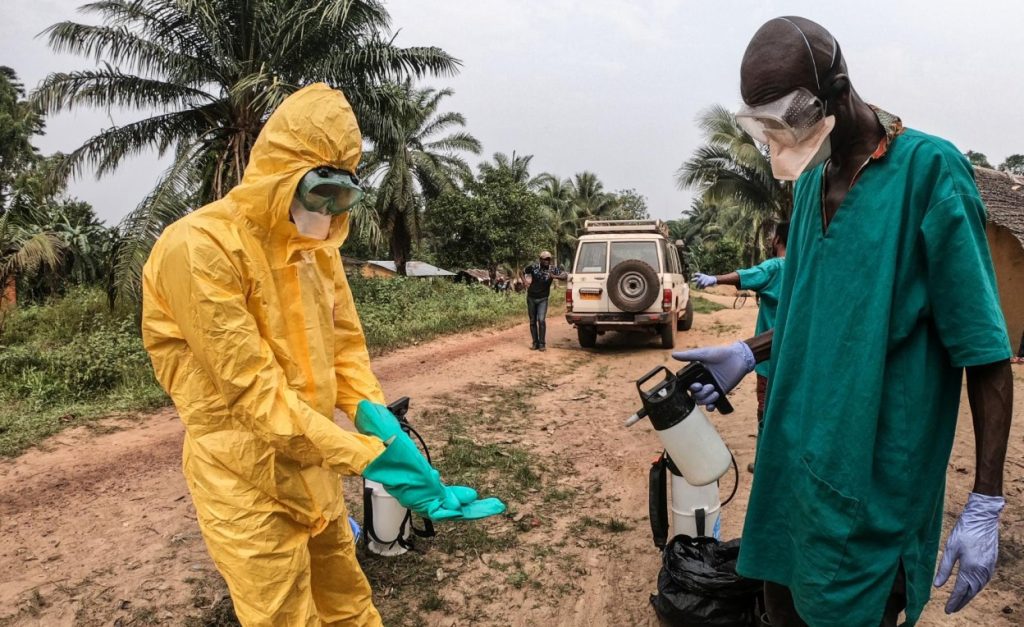
To deal with the threat, treatment centres are now being set up, isolation tents installed in hospitals, and medical supplies shipped to the outbreak zone, alongside responders from the Congolese health ministry and international organisations.
DRC has contained 16 previous Ebola outbreaks and has world-leading expertise, but past responses have also struggled, most notably to a 2018-2020 North Kivu-centred flare up, which was the first to unfold in an active conflict zone and became the second-worst outbreak in history.
The current epidemic is also unfolding in conflict-affected areas, as well as amid global aid cuts and a fraught political situation in the country, all of which could significantly complicate the response.
“A race against time”
Of chief concern is tracking cases and determining the true extent of the outbreak, with modelling by Imperial College London suggesting there could already be more than 1,000 infections.
Though it is unclear who patient zero is, the first known case died at a medical centre in Bunia, the Ituri capital, on 24 April. He was then buried 70 kilometres away in Mongbwalu, where mourners touched the body, unaware he had died from Ebola.
By the time an outbreak was declared on 15 May – following prolonged testing delays and transportation mishaps – people had been travelling around for weeks, making it difficult to figure out who had contact with those infected.
“Unfortunately, this was addressed very late,” said Claire Nicolet, an emergency coordinator with Médecins Sans Frontières (MSF). “It’s going to be a real race against time to try and trace the contacts who may have travelled and even crossed borders.”
Mongbwalu, the current epicentre, is a mining town that hosts thousands of artisanal diggers who work to extract small amounts of gold. A growing number of fatalities have been recorded there in recent days.
“There have been many deaths; today, I’ve seen several funerals, all without any protective equipment,” Daniel Mupenda, a miner who works in the town, said on 17 May in a telephone interview.
Issa Hassan, a Bunia resident who is secretary to the Ituri governor, said fear has taken hold over many people in his city – a commercial hub of hundreds of thousands of people – and he is wondering if his children should be attending school.
“The authorities are taking this very seriously, and the minister of health came from Kinshasa to assess the response capacity,” Hassan said. “But we are going to need the help of international partners.”
Other residents of Bunia have still been going about their daily activities. Churches have been full, roadside vendors are at work, and motorcycle taxis continue to carry passengers and goods.
In health facilities, however, the strain is more visible. MSF has reported that isolation wards are full, leaving some patients behind in the community and increasing the risk of further transmission.
Kahongya, the nurse who specialises in infection control in Bunia, said health workers are facing multiple challenges: insufficient protective equipment, a lack of funding, and transport and access constraints in some affected areas.
Still, he said local health facilities have the capacity to deal with the situation “thanks to the experience gained during previous Ebola outbreaks and the COVID-19 pandemic”.
Serge Kambale Sivyavugha, a researcher and general practitioner, cautioned that there is a lack of a “sufficiently resilient health system prepared to deal with this type of epidemic” because past responses have not built enough capacity on the ground.
“When interventions are managed exclusively from the central level and rely mainly on external teams, they do not strengthen the local system,” he said. “On the contrary, they create a dependency that becomes problematic as soon as these actors disperse.”
A limited toolkit
The second major concern is how to manage the outbreak without a licensed vaccine and approved treatments — key tools that have significantly improved responses to other Ebola strains.
Speaking to journalists including The New Humanitarian in Bunia on 21 May, Jean Kaseya, head of the Africa Centres for Disease Control and Prevention, said “a major vaccine research programme” is now underway with international partners.
Still, responders will be relying for now on core public health measures to break transmission, such as early case detection, isolation, contact tracing, and safe burials. These measures have controlled many previous outbreaks in DRC.
Some fear global aid cuts could hamper the response, just as they may have weakened DRC’s ability to prepare for the outbreak. The WHO is under particular strain after the US ceased funding and withdrew from the agency.
Pledges have still been made: The UK is providing $26 million, South Africa $2.5 million, the US $23 million, and the UN has allocated $60 from an emergency fund. However, this is well short of the nearly $1 billion mobilised for the 2018-2020 outbreak.
Stewart Muhindo, a researcher who studied the 2018-2020 epidemic, which also affected North Kivu and Ituri, said the funding cuts may turn out to be a blessing in disguise.
He said the scale of the spending in 2018-2020 created problems and detached the response from local realities. He gave the example of responders using large convoys to transport patients to treatment centres as an example of the disconnect.
At the time, communities questioned why a large-scale government and international response materialised for Ebola, but not for years of massacres or preventable diseases such as cholera and malaria. Some believed ulterior motives were at play.
The huge influx of money into the local economy also created incentive structures that led some individuals and groups to develop an interest in prolonging the outbreak, leading to what was locally referred to as “Ebola business”.
“By capitalising on the lessons learned from past experience and leveraging existing resources, it’s possible to compensate for this lack of funding,” Muhindo told The New Humanitarian.
Coordination concerns
The third critical issue is that the epidemic is unfolding in an unstable security context. There are multiple armed groups present in Ituri, and fighting has escalated over the past decade, involving different militias and the Congolese army.
Nearly a million people are displaced in the province – which has limited infrastructure and a poor road network – with many living in overcrowded camps. About 100,000 people were displaced in the first quarter of 2026 alone.
Dozens of armed groups also operate in North Kivu and South Kivu, including the Rwanda-backed M23, which has set up a parallel rebel administration headquartered in Goma, the largest city in eastern DRC.
The fragmented control of territory could have major implications for coordination between the state administration in Ituri and M23-run parts of North Kivu and South Kivu, with both sides already seeking to capitalise from the situation.
Congolese government spokesperson Patrick Muyaya said on 19 May that if Kinshasa is to mount an effective and urgent response to the epidemic, Rwandan forces and their M23 allies must withdraw from Congolese territory.
Rather than focusing on coordination, Muhindo said he had also heard M23 members “boasting that it is the government-controlled areas that will endanger us, but we are being rigorous”.
“There is a real risk that the response will be politicised, and we all know that when it is politicised, unfortunately, it leads to very significant damage,” Muhindo said.
One way to reduce politicisation, the researcher added, is to ensure that response efforts are integrated and coordinated through local health structures “rather than managed by political authorities”.
Sivyavugha, the researcher and general practitioner, echoed that view. He said the management of the outbreak should fall under the purview of competent national health bodies and not “actors driven by political considerations”.
Jacinthe Maarifa, a humanitarian worker with the local NGO AGIR-RDC, said both sides – the government and the M23 – have a “moral obligation” to work together, and expressed hope that UN mechanisms, including those of the WHO, will help.
One place to start, Maarifa said, would be reopening Goma airport, which is needed to bring in supplies and personnel but is non-operational due to the conflict and ensuing disrepair. The M23 says it would allow it to reopen if it is placed under its control, but Kinshasa would be reluctant to permit flights into rebel-held airspace.
Learning from the past
Although DRC has been battling Ebola for decades, and in some cases with great success, a fourth concern lies around the possibility of responders replicating mistakes from the 2018-2020 outbreak.
Seeking to prevent a repeat of the West Africa epidemic – the largest in history, with more than 11,000 deaths – responders and donors deployed a “no regrets” policy that saw hundreds of millions of dollars spent.
But the influx of resources and outside experts – whether from non-outbreak areas in DRC or abroad – was viewed with suspicion by many who had long experienced neglect or direct violence by the state and international organisations.
That wariness was exacerbated by the creation of a parallel health system, which saw treatment delivered outside of better trusted local health structures. Separate treatment centres were built and then largely dismantled when the outbreak ended.
“I remember, for example, that in all the areas where Ebola is currently raging, there were Ebola treatment centres, but they were built with tarpaulins,” Muhindo said. He called for responders to build more durable infrastructure “integrated into the local health system”.
The 2018-2020 response, led by the government and the WHO, also alienated communities by working openly with already distrusted soldiers and police who implemented draconian measures, such as forcibly transporting people to treatment centres.
In some cases, the WHO allegedly engaged local militias to provide security, yet this meant feeding into a volatile conflict ecosystem. Militias excluded from jobs launched attacks on health centres in an effort to secure a share of resources.
Women recruited to work in the response were, meanwhile, abused en masse, especially by WHO staff who made job offers contingent on sex. The situation, revealed by The New Humanitarian, snowballed into one of the worst sexual abuse scandals in UN history.
Already in the current outbreak, a hospital near Bunia was attacked by protesters seeking to retrieve the body of a young man who had died of Ebola. A well-placed medical source in the area said two tents were burned, an ambulance was damaged, and patients fled, including some who had tested positive.
Muhindo said he believes communities today do want to collaborate with responders but that the government and its partners will have to avoid past failures that “saw a lot of militarisation and a significant focus on money rather than on people”.
Maarifa, of AGIR-RDC, said the response must not give the impression of a centralised, external operation arriving to “to tell people how to live”. If it does, he added, “it will once again face ingrained [distrust] and accusations of profiteering.”
Sivyavugha agreed that it is critical not to militarise the response and instead to trust communities and their “significant knowledge” of disease management. An effective approach, he said, must be built with communities, not imposed upon them.
Above all, Sivyavugha added, the response should be designed to sustainably strengthen the health system, which means investing in local infrastructure such as diagnostic laboratories, and in local staff, rather than bypassing them as was done before.
“For me, managing an epidemic like Ebola can only be effective if measures are anticipated, rather than implemented only after the outbreak has been declared,” he said.


