
Agriculture: West Africa seeks to speed up the movement of seeds
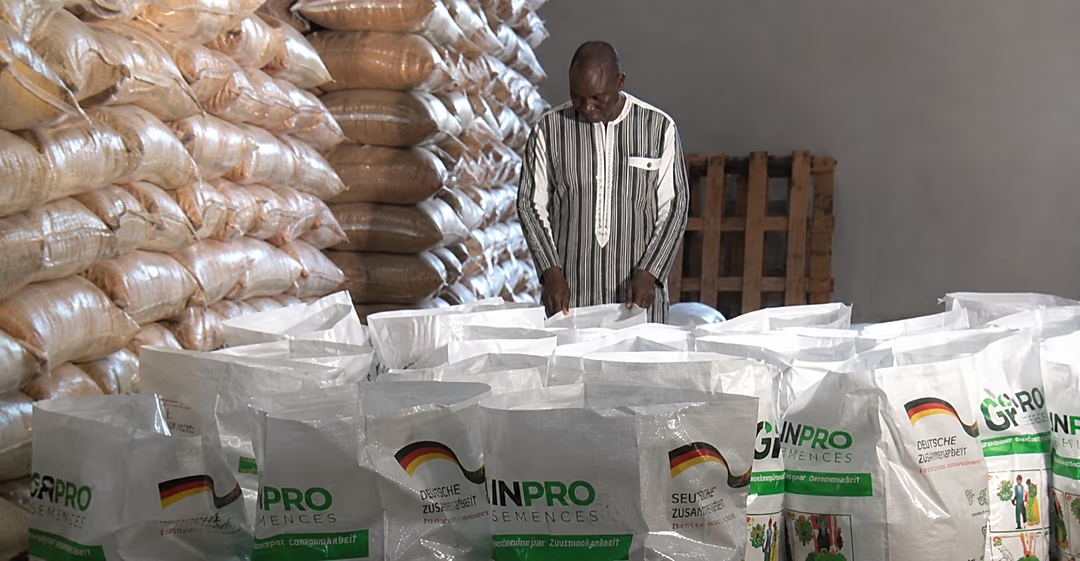
Agricultural seeds: West Africa seeks to lift barriers to regional trade
Ahead of the Africa Food Systems Forum in Kigali, West Africa wants to speed up the movement of crop varieties between its countries. The regulatory framework exists, but its application remains uneven, according to participants at a regional meeting organised by the Centre of Excellence for Seed Systems in Africa (CESSA).
“Seeds don’t speak French or English,” said Natasha Kofoworola Quist, AGRA’s regional director for West Africa. “We have what we need in the region: the scientists, the institutions, the entrepreneurs, the farmers and the markets. It’s all about making sure it stays connected.”
More than 200 researchers, entrepreneurs, regulators and financial partners from seven countries took part in the meeting, held in French and English on 20 August by the Centre of Excellence for Seed Systems in Africa (CESSA), an AGRA initiative.
Their assessment is a shared one: despite the progress made over twenty years, seed released in one country remains difficult to sell in another. The challenge is therefore no longer only to develop new varieties, but to allow them to be multiplied and distributed at regional scale.
Common rules, still unevenly applied
Since 2008, a regulation of the Economic Community of West African States (ECOWAS) has provided for the mutual recognition of certified seed. In principle, a variety listed in one member state’s national catalogue can also enter the regional catalogue.
An agreement concluded in 2018 between ECOWAS, the West African Economic and Monetary Union and the Permanent Interstate Committee for Drought Control in the Sahel extended that cooperation to 17 countries.
But implementation still varies widely from one state to another.
“In our space, there are three categories of countries: the advanced, the less advanced, and those moving more slowly,” said Ousmane Ndoye, representing the West and Central African Council for Agricultural Research and Development (CORAF).
He is calling for stronger training in seed technology, higher production of early generation seed, and national laboratories brought up to international standards.
A gap at the start of the chain
The availability of early generation seed is one of the main obstacles. Generally produced by public research institutes, it is what companies then use to multiply the seed sold to farmers.
“Its shortage limits the supply of certified seed, and it is sharpest for the varieties most in demand,” according to Ousmane Ndoye. In Nigeria, more than 90% of such seed still comes from public institutes.
Some companies are trying to secure their supply. In Mali, Faso Kaba has concluded multi-year contracts with national research, making it possible to plan production up to five years ahead.
Rapid multiplication techniques have also created a seed chain that barely existed for cassava and yam, where fewer than one in ten of the varieties bred reached farmers. “We have moved from scarcity to availability,” said Mercy Diebiru-Ojo, a specialist at the International Institute of Tropical Agriculture and a 2025 Africa Food Prize laureate.
The financing question
The financial partners present pointed towards the private sector. “If I had an additional dollar to invest, I would put it in the private sector, lending to them at affordable rates and good tenures,” said Martin Fregene, director of agriculture and agro-industry at the African Development Bank — a position Natasha Quist picked up on in her closing remarks.
“Government regulates and research supports, but entrepreneurs build the industry,” said Hermann Messan, country director of the International Fund for Agricultural Development (IFAD) in Côte d’Ivoire.
Twenty years of progress
Participants also took stock of the investment made over the past two decades. According to figures presented by CESSA, more than 650 scientists have been trained and more than 685 varieties released, of which around 60% have been commercialised. Around a hundred seed companies have been supported, and adoption of improved varieties has risen from 6% to more than 30%.
Several companies illustrate that progress. In Ghana, Antika Company says it has taken its annual output from fewer than 27 tonnes to 3,000 tonnes of seed. In Burkina Faso, NAFASO, founded in 2008 with a production of 100 tonnes, now claims a capacity of 6,000 tonnes and sells in several West African countries.
That record is also debated: African civil society organisations argue the model has favoured a few crops at the expense of diversity. Abdoulaye Sawadogo, the founder of NAFASO, considers the criticism overstated, while finding it “useful, because you have to keep an open mind”. “Let us not forget the essential,” he adds. “Our shared challenge is to feed Africa ourselves.”
‘Taking it regional’
For Natasha Quist, the next step is at that level. “The examples of national success are there, in Burkina Faso, in Mali, in Nigeria. It’s now about taking it regional, harmonising, particularly around the critical varieties, and making sure things are standardised so that we can trade.”
“Our markets, our corridors, our borders are all important parts of getting it right over the region, so that food moves around the region,” she added, saying she wanted this kind of meeting to become “a regular fixture, and not just a one-off”.
“Twenty years, we’ve worked hard. Now we need to work smart,” concluded Folarin Okelola, of Nigeria’s National Agricultural Seeds Council.
The issue is expected to be discussed at the Africa Food Systems Forum, held from 1 to 4 September in Kigali, and then at the African Union’s first summit devoted to seeds, scheduled for 5 to 7 October in Mbabane, Eswatini.