Congo-Brazzaville: Congo’s Wealth Is Not Yet Power
Across Africa, the decisive economic contest lies between raw material and finished product. For cotton, it is the distance from fibre to fabric. In the Democratic Republic of Congo, it is the distance from mineral and hydropower wealth to electricity, industrial capacity and productive work. The sectors differ, but the development question is the same: who captures the value created between extraction and the final product?
The Democratic Republic of Congo contains a startling share of the raw materials on which the modern economy depends. It is the world’s leading producer of cobalt. It has vast copper deposits, one of the planet’s great river systems and a population of roughly 100 million people, most of them young. On a map of the energy transition, the country appears indispensable.
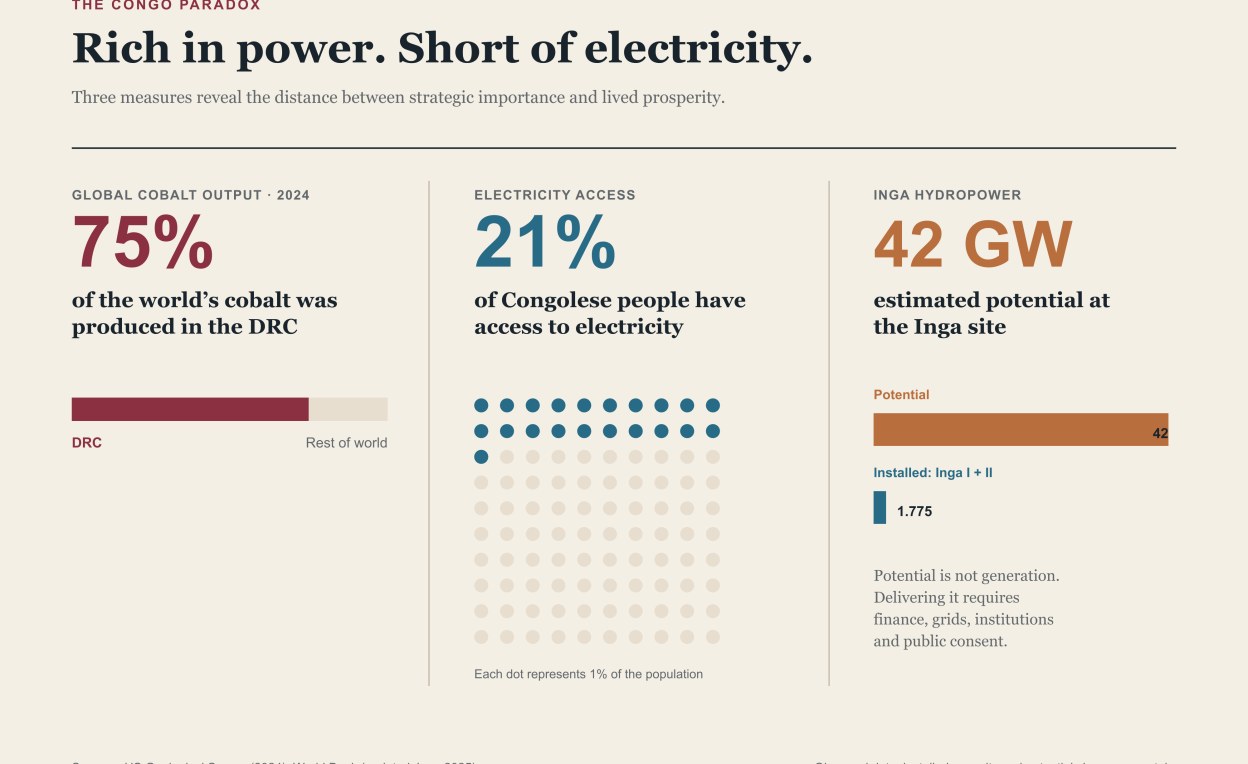
On a map of lived prosperity, it looks very different. Only about 21 per cent of Congolese people have access to electricity, according to the World Bank. Poverty remains deep, insecurity persistent and the state distant or predatory for many citizens. The country’s most important economic question is therefore not how much wealth lies beneath its soil or runs through its rivers. It is whether that wealth can be converted into power, production and broadly shared opportunity.
That distinction separates endowment from development. Congo has never lacked resources. It has lacked the durable institutions and infrastructure that allow resources to become public value.
An extractive inheritance
The origins of that failure reach back to the formation of the state itself. Under King Leopold II, the Congo Free State became synonymous with forced labour and brutal extraction. Coercive labour practices persisted after Belgium assumed direct colonial rule in 1908, and a genuinely free labour market emerged only slowly before independence in 1960, according to academic research cited in the original manuscript.
The colonial economy was designed to remove value and administer territory, not to cultivate a broad Congolese political, managerial and technical class. At independence, the country inherited immense land and mineral wealth but little indigenous administrative capacity. A World Bank historical assessment cited in the manuscript describes both the shortage of trained Congolese personnel and Belgium’s effort to retain influence through technical advisers placed alongside key officials.
The crisis that followed independence, the assassination of Patrice Lumumba, Mobutu Sese Seko’s long authoritarian rule and the Congo wars deepened those institutional weaknesses. Mobutu did not invent the extractive state, but his personalised system entrenched it: institutions weakened, patronage expanded and public resources served political survival. Later conflicts and regional interventions fragmented authority further and allowed armed groups to flourish.
This history matters not because it condemns Congo to failure, but because it explains why geology alone has proved such a poor development strategy. Resources create possibilities. States, markets and public institutions determine who captures them.
From quarry to factory
The scale of the opportunity is nonetheless exceptional. The US Geological Survey estimated that in 2024 the DRC accounted for about 75 per cent of global cobalt production and roughly 55 per cent of global reserves. It was also the leading producer of tantalum and among the leading producers of copper, diamonds, tin and other strategic minerals.
These materials sit inside the energy, electronics, telecommunications, defence and manufacturing supply chains that are reshaping global commerce. Yet the familiar model remains one in which the highest-value activity occurs elsewhere. Minerals are extracted in Congo; more sophisticated processing and manufacturing take place abroad.
The policy choice is often described as one between exporting minerals and exporting products. But moving from one to the other requires more than declaring an industrial ambition. Copper processing, battery materials, electrical equipment, construction inputs, machinery and chemicals all require dependable electricity, transport, skills, capital, enforceable contracts and access to markets.
The real transition, then, is not simply from “quarry” to “factory”. It is from an extractive system to a productive one. The measure of success is not how many tonnes leave the ground, but how much capability, employment and domestic value are created before they leave the country.
The river and the grid
Congo’s most consequential industrial asset may be the one that flows through it. The Congo River and its tributaries give the country extraordinary hydropower potential. The Inga site alone has an estimated capacity of about 42,000 megawatts, which the World Bank describes as one of the world’s largest hydropower opportunities.
That number is dazzling. The national power deficit is sobering. With electricity reaching only about one in five people, the first claim on Congo’s hydropower future must be domestic: households, schools, clinics, farms and businesses that cannot develop without reliable power. The country’s National Energy Compact aims to raise access to 62 per cent by 2030, potentially reaching about 82 million people, according to the World Bank.
Power is also the bridge between Congo’s mineral base and its industrial ambitions. A processing plant cannot run on geological promise. Mines, smelters, factories and cities need generation connected to functioning transmission and distribution networks. The Inga opportunity therefore cannot be judged only by installed capacity. It must be judged by whether electricity reaches Congolese users reliably and affordably.
Regional trade could extend the value of that system. The DRC participates in the Southern African Power Pool, and electricity from Inga has historically been supplied to countries including South Africa and Zimbabwe. The World Bank has identified stronger transmission links between Inga, Zambia and the wider southern African market as strategically important.
The proposed Inga 3 project illustrates both the promise and the uncertainty. World Bank analysis cited in the manuscript places its possible generation between 2 and 11 gigawatts, depending on the final design. Congo’s position could eventually allow power to move across southern, central and eastern African pools. But “could” is the operative word. Regional electricity trade depends on finance, transmission lines, credible contracts, regulatory alignment and political confidence—not capacity estimates alone.
Europe’s interest, Congo’s choice
The strongest European connection is not a speculative cable from the Congo River to European homes. It is the prospect of a different industrial relationship. Europe seeks secure supplies of critical minerals and lower-carbon industrial inputs. Congo needs energy, jobs and greater value addition.
If renewable power can be combined with copper, cobalt and other minerals, Congo could produce more of the intermediate goods required by the energy transition. That would allow trading partners to buy higher-value Congolese output rather than raw material alone.
But the arrangement will be developmental only if industrial capacity takes root inside Congo. Supply security for foreign buyers is not the same as prosperity for Congolese citizens. The terms of contracts, the distribution of rents, local skills, environmental safeguards and the strength of domestic suppliers will decide whether a new mineral boom merely modernises extraction or changes the structure of the economy.
A young country needs work
The urgency is demographic. A World Bank assessment cited in the manuscript estimates that almost 65 per cent of the population is under 25. About 22 million people were aged 15 to 24 in 2025; that figure is projected to reach roughly 26 million by 2030. About a third of young people are neither in education, employment nor training, while roughly 40 per cent struggle to find work.
A young population is neither automatically a dividend nor inevitably a danger. It becomes an economic advantage when education, electricity, investment and functioning markets allow people to be productive. Without those conditions, demographic scale can intensify exclusion and instability.
This is why Congo’s industrial debate must be about jobs as much as exports. Capital-intensive mining can generate revenue without employing people on the scale the country requires. Processing, construction, energy, logistics, agriculture, services and regional manufacturing offer a broader employment base—but only if skills policy and industrial policy are designed together.
Peace as economic infrastructure
No such strategy can succeed while conflict continues in the east. Violence is first a human catastrophe. It is also a destruction of economic possibility: roads go unbuilt, schools are disrupted, responsible investment becomes harder and informal or illicit systems gain ground.
The IMF has identified governance weaknesses, mineral dependence, youth exclusion, conflict and the regional dimensions of insecurity among the DRC’s drivers of fragility. The implication is that peace cannot be treated as a security file isolated from economic policy.
The DRC and its neighbours have a material interest in replacing the economics of conflict with the economics of connection. Electricity links, roads, railways, ports, digital networks, agricultural value chains and lawful cross-border trade can raise the opportunity cost of destabilisation. Integration is no guarantee of peace. But an economy organised around shared production and exchange offers a stronger foundation than one organised around contested extraction.
Finance, and the test of delivery
Development institutions have begun to finance parts of this agenda. As of September 2023, the African Development Bank’s active DRC portfolio consisted of 27 operations worth about $1.45bn across transport, information and communications technology, energy, water and sanitation, and agriculture. Its 2023–2028 country strategy focuses on industrialisation, employment, infrastructure, agricultural value chains, human capital and the business environment.
The energy commitments cited in the manuscript include $22.4mn in parallel AfDB financing alongside $73.1mn of World Bank support approved in 2014 for Inga-related technical assistance. In December 2024, the AfDB was appointed mandated lead arranger for the $340mn Moyi Power Metro-Grids project, intended to bring cleaner, more reliable electricity to more than one million people in three cities.
These commitments show that Congo’s needs are recognised. They do not, by themselves, prove transformation. Portfolios, strategies and mandates are inputs. The meaningful outputs are functioning grids, reliable transport, competitive firms, transparent institutions and work that pays.
The missing chain
Congo’s agenda is often presented as a list: better mining contracts, more roads and rail, stronger security, technical education, regional power links, a better business climate. Each item is necessary. The more difficult insight is that they are interdependent.
Electricity without transmission cannot power a factory. A railway without predictable freight may not be financeable. Mineral processing without skills and reliable energy will not compete. Investment without accountable institutions can reproduce the very extractive bargain Congo needs to escape. Peace without legal economic opportunities may remain fragile.
The country therefore needs more than projects. It needs a sequence: secure productive regions; improve public institutions and contract transparency; expand electricity access and transmission; connect mines, farms and cities to markets; build technical capabilities; and use mineral and energy policy to support industries that can compete.
None of this is quick. Nor is it guaranteed. The same resources that make Congo strategically valuable also intensify struggles over rents and influence. Large infrastructure can create debt, displacement and governance risks if projects are badly designed. Regional interconnection creates opportunity, but it also requires patient diplomacy and institutions able to enforce agreements.
Yet the alternative is not stasis. Global demand for strategic minerals is placing Congo closer to the centre of the world economy. The country can remain indispensable as a source of raw materials while its citizens remain excluded from the value those materials create. Or it can use this moment to negotiate a more productive bargain.
The real test will not be whether the Democratic Republic of Congo finally “wakes”. Countries are not giants in fairy tales. They are political economies, built through choices and constrained by institutions.
Congo already has the assets. What it has not yet secured is the chain that joins them: peace to investment, power to production, minerals to industry, and national wealth to household prosperity. Building that chain would not merely alter Congo’s fortunes. It could change the economic geography of Africa.