Mali: Rebels Now in Control of Key Mali Town After Attacks
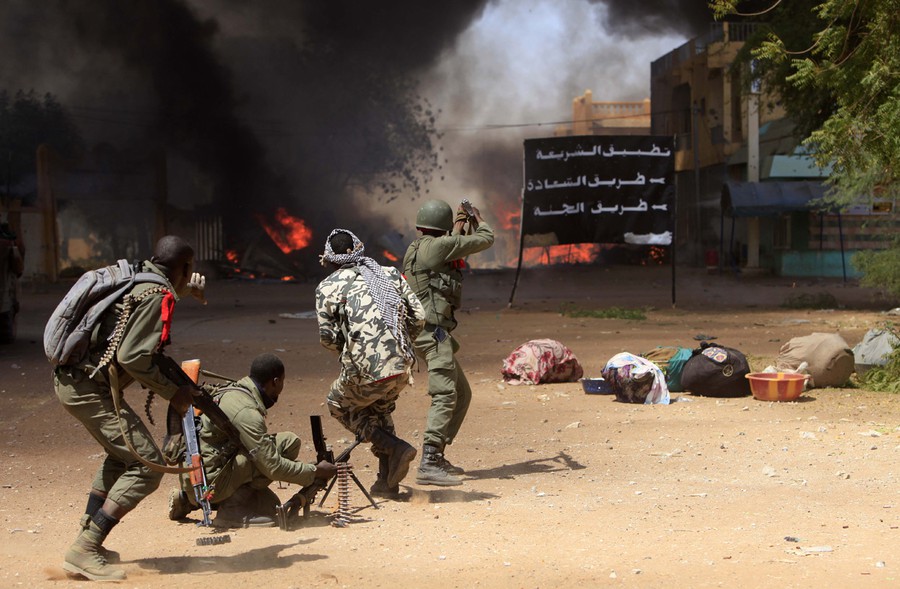
Jihadists and Tuareg separatists in Mali have taken control of the key northern town of Kidal after coordinated attacks on strategic junta positions across the country, an ally of the local governor and local sources said.
Two days of fierce fighting between the army and jihadists allied with Tuareg rebels have plunged the junta-led West African country into uncertainty over the military government’s future.
Several strategic towns and areas around the capital Bamako were targeted in a dawn offensive on Saturday.
“We have left Kidal. We are no longer there. It’s the jihadists and the FLA (the Azawad Liberation Front) who are in Kidal,” a source close to the governor told AFP.
Residents also confirmed to AFP having seen Malian soldiers and their Russian mercenary backers leaving the town.
The FLA, a separatist group claiming the territory of Azawad in northern Mali, had said over the weekend that it had “total” control of Kidal, marking a major blow to Mali’s military junta.
Speaking to ORTM public television on Sunday, the army’s chief of staff announced a “readjustment” and “redeployment” of the military presence in the area of Anefis, 100 kilometres (60 miles) from Kidal.
Kidal, a pro-independence stronghold, had been under the control of rebel groups for years before being retaken in November 2023 in a Malian army offensive, supported by Russian mercenaries from the Wagner Group.
Its recapture was widely hailed across Mali as a symbolic success.
Mali’s turmoil since 2012
Mali’s latest wave of attacks by jihadists and Tuareg rebels is a new chapter in a security crisis that has for years shaped the country.
In 2012, northern Mali was plunged into chaos when ethnic Tuareg rebels launched a campaign for independence or special status.
Jihadists soon joined the rebellion, turning the north into a launchpad for an Islamist insurgency that has since swept into neighbouring Niger and Burkina Faso.
Since independence in 1960, Mali has faced repeated uprisings by the Tuareg, a nomadic Saharan people of Berber origin, driven by grievances against southern rule.
In March 2012, soldiers overthrew President Amadou Toumani Toure, accusing him of failing to contain a Tuareg-led separatist rebellion and the advance of Islamist armed groups in the north.
The coup triggered a security crisis that saw Tuareg rebels and jihadists linked to Al-Qaeda in the Islamic Maghreb (AQIM) seize major northern towns.
The Tuareg were later pushed aside by jihadist groups, who took control of the region.
Jihadists were partially driven back by France’s Operation Serval in 2013. That was later replaced in 2014 by the broader counter-terrorism mission Operation Barkhane across the Sahel.
The United Nations also deployed its peacekeeping mission, MINUSMA, taking over from a pan-African force.
In 2013, Ibrahim Boubacar Keita – known as IBK – was elected president.
A peace agreement was signed in 2015 between the government and northern separatist groups.
Despite the deal, jihadist violence continued, increasingly overlapping with deadly communal clashes.
Soldiers overthrew IBK in a 2020 coup. A transitional president was appointed, but was himself ousted in a second coup in 2021.
General Assimi Goita emerged as head of the ruling junta, gradually abandoning promises of a return to civilian rule.
Relations with Western partners deteriorated. By 2022, French troops and the UN mission were pushed out.
Mali instead turned to the Russian paramilitary group Wagner for security support.
After eight years of relative calm, fighting flared again in northern Mali in August 2023 between Tuareg-dominated armed groups and the army.
In September, separatists launched an offensive on the garrison town of Bourem, which the army said it repelled. Both sides reported dozens of deaths.
This renewed separatist activity coincided with a surge in attacks claimed mainly by the Group for the Support of Islam and Muslims (JNIM), an Al-Qaeda-linked alliance.
The Malian army, backed by Wagner fighters – later replaced by Russia’s paramilitary Africa Corps – captured rebel stronghold Kidal in November 2023, ending years of Tuareg control.
In January 2024, the junta announced the immediate end of the 2015 peace deal.
July 2024 saw one of Mali’s worst military setbacks in years. Government forces and their Russian allies suffered heavy losses in clashes with separatist rebels near Tinzaouatene in the north, alongside a jihadist attack.
In September, JNIM claimed a large-scale double attack on the capital Bamako’s military airport and the military police training school, killing more than 70 people and wounding 200, according to security sources.
Mali, Niger and Burkina Faso – all ruled by military juntas – formed the Alliance of Sahel States (AES), announcing plans for a 5,000-strong force to combat jihadist groups.
In September 2025, JNIM launched a strategy aimed at strangling Mali’s economy by imposing blockades on several towns and fuel convoys.
By Daily Trust.

