Nigeria: Court Jails Canada Returnee 11 Years for Importing, Possessing 2.5kg of Cannabis

Justice Akintayo Aluko of the Federal High Court in Lagos has convicted and sentenced a Canadian-based Nigerian, Abimbola Daniel, to a total of 11 years’ imprisonment for unlawfully importing and possessing 2.5 kilograms of Cannabis.
Justice Aluko jailed Daniel after he pleaded guilty to a two-count charge filed against him by the National Drug Law Enforcement Agency (NDLEA).
The NDLEA accused the convict of unlawful importation and possession of Cannabis, offences punishable under Sections 11(2) and 20(1) of the National Drug Law Enforcement Agency Act, Cap N30, Laws of the Federation of Nigeria 2004.
The prosecutor, Arit Okon, claimed that the convict imported the prohibited substance from Canada via an Ethiopian Airlines flight.
Okon also told the judge that the drug was concealed in cargo covered by waybill number 07161185795 and brought into the country through the Customs Import Shed at Murtala Muhammed International Airport, Ikeja, Lagos.
The prosecutor further informed the court that Daniel engaged Afriway Cargo and Logistics, situated at 20B Anthony Udo Avenue, International Airport Road, Ikeja, to clear the cargo.
He was arrested when he arrived to collect the consignment.
After his arrest and the completion of investigations, the NDLEA charged him with unlawful importation and possession of 2.5kg of Cannabis.
Based on the convict’s plea, the prosecutor called an exhibit keeper for the agency, Abdullahi Musa, who reviewed the facts of the case and tendered the exhibits recovered from the defendant.
The court admitted these exhibits as evidence.
Okon then urged the court to convict and sentence Daniel based on his guilty plea, the evidence presented, and the provisions of the Administration of Criminal Justice Act (ACJA) 2015.
However, the defence counsel, Chief Benson Ndakara, urged the court to consider Daniel’s early guilty plea and the fact that he had no prior criminal record when sentencing him.
Ndakara also relied on relevant provisions of the ACJA to request a non-custodial sentence.
In his judgment, Justice Aluko noted that Daniel had no previous convictions, considered both parties’ arguments and the legal authorities cited by counsel, and subsequently sentenced the convict to five years’ imprisonment for the first count and six years for the second count, totalling 11 years.
The court offered him the option of paying a fine of N500,000 for the first count and N600,000 for the second, in place of imprisonment.
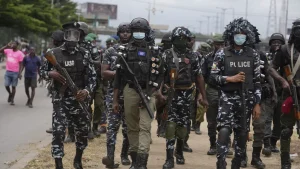
The Police Must Come With Human Rights Safeguards — Ojukwu By Bidon Mibzar, Abuja The Executive Secretary of the National Human Rights Commission (NHRC), Chief Anthony Ojukwu, OFR, SAN, has advocated the urgent establishment of State Police, saying decentralising the nation’s policing system would improve security, reduce response time and strengthen protection for citizens.
OjuKwu made the call in Port Harcourt on Tuesday during a panel session at the 66th Annual General Conference of the Nigerian Bar Association (NBA), themed “Beyond Limits.”
They said Nigeria’s centralised policing structure had become overstretched, resulting in delayed responses to security threats and leaving many citizens vulnerable.
“If you don’t have State Police, you can never have adequate security. We have over 200 million people in Nigeria with far fewer police officers to police them. The response time is so long that we only live by God’s grace,” he said.
According to him, State Police would allow law enforcement agencies to respond more effectively to local security challenges because officers operating within states and communities would have a better understanding of the terrain and the people.
With State Police, the governors will have the wherewithal to respond quickly. The police will be more effective because they know the terrain; they know the people,” Ojukwu stated.
However, the NHRC boss warned that decentralising policing must not become an avenue for political interference or abuse of citizens’ rights. He insisted that strong safeguards, accountability mechanisms and independent oversight must back any State Police framework.
We must insist that, when the National Policing Bill comes, it is well drafted. There must be a board that runs it. There must be oversight. Otherwise, it will become another problem, “he cautioned.
Ojukwu stressed that effective policing should be judged not solely by the number of arrests or suspects apprehended, but also by the extent to which security agencies uphold human dignity, due process, the rule of law, and fundamental rights.
He urged lawyers and citizens to remain vigilant and hold security agencies accountable, particularly in cases involving arrest and detention.
“Awyers should be the people to insist on the right thing to do. If the police are going to arrest anybody, insist on the right procedure. Don’t let them abuse power. We have to watch them, “he said.
The NHRC Executive Secretary maintained that security and human rights should not be treated as opposing objectives, arguing that lasting security could only be achieved through a system anchored on professionalism, legality, accountability and respect for fundamental rights.
He said persistent insecurity and slow responses to emergencies had weakened public confidence in security institutions, leaving many Nigerians feeling that their safety largely depended on chance.
Your people live by God’s grace because the system is not working. That must change,” he added.
Ojukwu, therefore, urged Nigeria to move beyond an overstretched policing structure and adopt a system capable of responding more efficiently to local security realities while ensuring that citizens’ rights remain protected.
“We cannot continue with a system where only a few police officers are expected to secure millions. It is time to go beyond limits and give Nigerians the security they deserve; securely, effectively and accountably,” he said.
By Leadership.